Pages

Saturday, November 15, 2014

Khon Kaen Tri-District Conference

On 18 – 19 October Elder and Sister Moleff attended the Khon Kaen, Udon, and Ubon, Tri-District, conference located in Khon Kaen.  Also on Sunday 19 October, Elder and Sister Moleff attended a Church History Fireside at the Changwattana Chapel.  In addition to serving as a Family History Missionary, Sister Moleff also records the Mission History.

Buses were rented to take members of each district to the conference.  Affordable rooms were rented at police and military establishments to house church members from Saturday evening to Sunday morning

The Saturday session of Conference was held in a large assembly hall in the Ampur Muang Government building.  Internet was not available in the conference hall.  We provided Family History training via Power point presentation.  The Saturday session was presented differently than any other previous district conference session in that booths were prepared that displayed different gospel topics.  The object was that a group of members would move from booth to booth to receive the gospel message prepared for a particular booth.  Family History shared its booth with one on the Endowment.  Lunch and dinner were provided by church members.

A Cultural Program followed the Saturday Session of Conference.

NOTE:  We talked with Elder and Sister Singley, and they support establishing a FH Center in Vientiane, Laos.

Saturday 18 October 2014 Session of Tri-District Conference


Our Family History Booth Backdrop designed by Wisan Manager of Service Center and make by non-member in Khon Kaen.

Our Family History Booth

Sister Wan Interpreting for Elder Moleff.  The fan displayed behind Elder Moleff was made for him at the Umbrella & Fan Company in Chiang Mai.  It is his fan chart as displayed on FamilySearch hand painted on silk.
Sister Wan Doing A Family History Presentation

Endowment Booth

Priesthood Booth

Self Reliance and PEF Booth.  Elder Sepi Speaking.

Thailand 5000 Booth.  Goal is for 5000 to Attend Sacrament Meeting


President Senior Doing the Thailand 5000 Presentation.  
Thailand 5000 is a goal to have 5000 members attend church on 21 December 2014, 
group pictures will be taken after church that day.

There was a cultural event held Saturday evening.
these next pictures are of the dancers from various communities in the Districts.     


Thai Dancers. 
 Sister Moleff had her picture taken with these dancers and the finger decorations.


Notice the One in the Middle out of Uniform
Sister Moleff and Sepi at a park in Khon Kaen


Sunday 19 October 2014 Session of Tri-District Conference


The Sunday session of conference was held at the Charoenthani Khonkaen Hotel where Elder 
and Sister Moleff stayed during district conference. The president authority was Elder Gong
Asia Area President with Elder Khanakham (Area Seventy), and President Senior 

(Mission President) being present.


The conference consolidated the Khon Kaen, Udon, and Ubon districts into the Udon, and 
Ubon districts with the Khon Kaen district being eliminated. The paperwork to create the 
Ubon Stake will be submitted by the end of 2014; and the Udon stake in June 2015. 
New district presidencies and a reorganized mission presidency were sustained.
Photographs are as follows:


Elder Khanakham Conducting.
Elder Khanakham is the first Area Seventy from Thailand. 
He was sustained in April 2014 General Conference
Elder Gong Presiding.  
Asia Area President.
President Wongsagong his interpreter also President of the Udon Disrtict.

Old Udon, Khon Kaen, and Ubon Districts

New Udon and Ubon District

New Ubon District Presidency:  1st Counselor Prawit Soyson;  President Amporn Parapan; 
 2nd Counselor Siridech Sirisukprasert


Our New Missionary District

Sister Moleff started the tradition of going to Swensens ice cream parlor during the week of a missionaries birthday.  It was Elders Moleff's birthday so we went to Big C, where there is a Swensen.   Because we have District Meetings on Tuesdays that is the day we go, which is good because on Tuesdays when  you buy 1 scoop you get another scoop free.  So District Meeting then Swensens.

Swensens was started in 1948 by Earle Swensen, who had learned to make ice cream while serving in the U.S. Navy during World War II.   Swensen opened his first shop at the corner of Union and Hyde Streets, along the cable car tracks in Russian Hill in San Francisco at what had been a failed ice cream parlor. Although vanilla was his lifelong favorite, he developed more than 150 flavors, which he marketed under the motto "Good as Father Used to Make". The original store sold ice cream and other frozen dessert specialties (such as sundaes and banana splits), with primarily take out service. Later other Swensen's franchisees added indoor seating and offered various types of food, including sandwiches and hamburgers.

Today the company is owned by International Franchise Corp (IFC) of Markham, Ontario, Canada, which bought the franchise business from former frozen food manufacturer CoolBrands International in 2006.  The Swensen's chain now includes about 300 franchise outlets worldwide including locations in Asia, the Middle East, the United States, South America, India, Taiwan, Singapore, Cambodia, Malaysia, Philippines, Vietnam, Thailand and Laos.

The company opened its first store in India at Mantri Mall, marking the first of 80 stores over the next 5 years scheduled to open in South India. Swensen's is also now open in Ho Chi Minh City, Vietnam. In March 2014, Swensen's first restaurant in Yangon, Myanmar opened for the first time.


Swensen's serving staff
Our Table


Waiting for our order.  Plus with a Swensens card (which Sister Moleff now has) you also get 10% off your order - Tuesday is a great day to go to Swensens.  Elder and Sister Manning (previous Public Relations Senior Couple) introduced us to Swensens - THANKS.
L-t-R: Elder Howard, Elder Hogan, Elder Kettavong, Sister Moleff, Elder Moleff, Sister Lam, Sister Brown, Elder Davis, Elder Crump, and District Leader Elder Omer

Elder Moleff's 76th Birthday Dinner

Sister Moleff took Elder Moleff to Thailand to celebrate his 76th birthday.
She took him to 1st to the Kamthieng House Museum;
 2nd to the Jim Thompson House & Museum and to lunch,
then to the Central World Plaza Mall for dinner, and, of course, to Swensens for ice cream.
Elder Moleff had a VERY GOOD birthday.  A few photos below:

One of the things that we saw in the Mall was Santa flying around with his reindeer

The Senior Couples stationed at the Service Center helped me celebrate my birthday. 
 Elder Moleff choose to eat at a Thai restaurant - he LOVES Thai food.
Elder Meeker , who served a mission here as a young man, ordered after we told 
him our requests.  The Thai food was served Family Style so that all had a taste 
of the different dishes.  The meal was very good.
L-t-R:  Sister Smith, Sister Ure, Sister Seppi, Sister Meeker, Sister Moleff,

 Elder Moleff, Elder Meeker, Elder Seppi, Elder Ure, and Elder Smith. 
 The Smiths are Public Relations; The Ures aare Humanitarian; The Seppis are PEF;
 The Meekers are the Office Couple and the Moleffs Family History.
A very fine group of people.

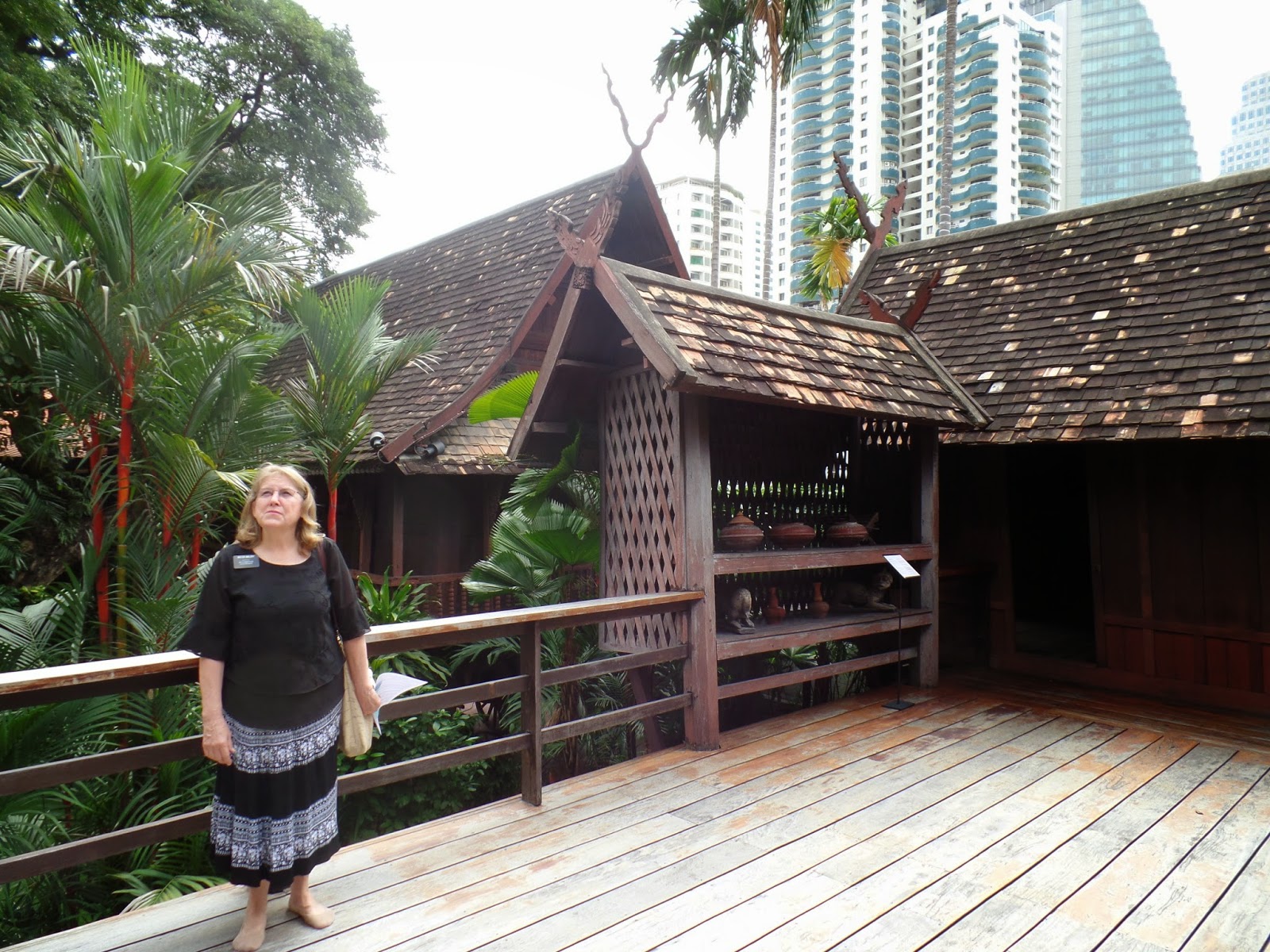
Jim Thompson House & Museum

Jim Thompson House Museum, Bangkok Thailand
The Jim Thompson House Museum is the former home of James H.W. Thompson, a self-made American entrepreneur who was the founder of the world renowned Jim Thompson Thai Silk Company. Arriving in Bangkok at the end of World War II, Jim Thompson became passionately interested in Southeast Asian art and antiques. He purchased several old teak houses to create his own unique home in Bangkok in order to house his growing collection. The original Jim Thompson house and outbuildings were re-constructed from all or sections of six separate old houses that were brought from various parts of the country.  After Jim Thompson’s mysterious disappearance inMalaysia in 1967, his nephew Henry B Thompson III generously donated the house and its collection to the people of Thailand.  Open daily to the public for guided tours in English, Japanese, French and Thai, the museum is operated by The James H W Thompson Foundation. Generally the museum remains the way it looked when Jim Thompson lived there, however the Foundation has slightly rearranged certain displays in the interest of security.  Two small buildings, formerly used by household staff, have been turned into additional museum display space.
The Jim Thompson Art Center, a large gallery purpose-built to house special exhibitions is located in the same compound. Exhibitions in the Art Center generally focus on Asian topics or textiles, and range from traditional to modern in theme.  In addition to exhibitions, the Art Center conducts educational and outreach programs, produces publications and collaborates with local and international cultural institutions.  The Art Center also includes in a separate building, the William Warren Library.
As a small independent museum, belonging to an international organisation like ASEMUS that supports museums, will be of benefit in terms of resources, networking and sharing information about our programs.
Jim Thompson House Museum, Bangkok Thailand

Collection size:  1,600 objects
Collection: Asian and Southeast Asian paintings, ceramics, sculpture and object d’art acquired by Jim Thompson.
The collection includes:
Paintings: The Thai paintings in the Thompson collection are on cloth, paper and wood. Most are on cotton and range from fairly small to tapestry size. The subject matter generally relates to either the life of Buddha or the popular Jataka stories, in particular the legend of Prince Vessantara, who shows the virtue of Charity by giving up his worldly possessions, his wife and children.
Ceramics:  The collection includes Chinese export ware, mainly blue and white porcelain, of which numerous pieces found their way to Thailand in the sixteenth and seventeenth centuries. There is also a large collection of Benjarong ware, porcelain originally made to order in China for the Thai nobility.  Sukhothai and Sawankalok wares produced in kilns in Thailand also figure in the collection as do Lopburi and Khmer wares.
Sculpture:  The sculpture in the museum is Southeast Asian, and is principally from Thailand andCambodia, with a few pieces from Burma. The collection includes stone Khmer statues and Buddha images and Burmese wooden figures
Furniture:  The museum has an extensive antique collection of carved, painted and inlayed Thai-Chinese furniture including altar tables, beds and cabinets.  In addition, there is the contemporary furniture Jim Thompson used in his home.


Original architectural drawings for the house, prepared by Thompson and his Thai architect.
During construction, carpenters were brought from Ayutthaya to assemble the old structures.
 
The Jim Thompson House Floor  Plan
Where Sister Moleff took me to lunch at the Jim Thompson House restaurant.  
This is a very restful setting.  If you ever come to visit we will take you to lunch here.
 The Jim Thompson House and grounds are only open from 9am to 5 pm.


A Thai lunch.  The green drink is called Lemon-Grass.  We had the Golden Triangle- crab cakes, prawns wrapped in rice paper, and shrimp - dish on the left.  Middle dish is stir fried vegetables (carrots, baby corn, bamboo shoots, mushrooms,  bell peppers {red & green}, and onions in oyster sauce.  And last rice.  We love the presentation and it tasted even better.
Pulling the thread from the Silk Worm Cacoon.  It is hard to tell but he is pulling
 about a dozed small threads through the hole in the lower wooden bad and 
then he just layers it in the basket.

She is taking the thread from the basket and making hanks of Silk thread. 
 Years ago Sister Peaden gave me three silk cacoons. Now I know what to do with them.

Photos are not allowed in the buildings.  These are photos of the grounds outside 


Silk Worm Cocoons
Silk worms are actually a type of caterpillar that spins silk cocoons around themselves after they turn approximately 1 month old. Whenever they are finally ready to start spinning their cocoon, they will stop eating any food and then they will turn yellowish. At this point, it will then take the silk worm approximately 3 days to spin their cocoon around themselves. If their threads are disturbed by anything, the silk worm will have to start all over again spinning a new cocoon.

The silk that is used in forming these cocoons is actually hardened silkworm saliva that has been secreted from the silk worm's mouth. There is actually a small spinneret that is located on the silk worm's lip, which is used to excreet the silk that they use to form their cocoon. This single strand of silk that the silk worm forms is about 1 mile long. Silk worms have to work in a figure 8 pattern in order to spin their cocoon around themselves.

While spending 3 weeks inside of the cocoon, they shed their skin and change into a pupa and then into moths. The moth will then emerge from its cocoon at dawn by secreting a special spit so that the silk can be dissolved and the moth can emerge. Their wings will be wrinkled before the air puffs them up in an hour and they will also “urinate” a reddish-brown fluid shortly after emerging from their cocoon since it couldn't “pee” while inside of the cocoon. They cannot eat or drink, but they go on to mate for 1 day before laying eggs and dying 5 days later. A female moth can lay between 200 and 500 eggs, which will then hatch into worms in a few weeks and carry on this continuous life cycle.


Wan, our English speaking guide that gave us a good tour.
Both the museum and the house only cost 100 ฿ per person to visit,  1 ฿ = $0.03.  
Entrance fees to the museums was $3.04 each.

Kamthieng House Museum

Kamthieng House
the Lanna legacy in Bangkok


Lanna house with kalae on the gable
Kamthieng House, a traditional Lanna home in the grounds of the Siam Society on Soi Asoke Bangkok, preserves the 700 hundred year old Lanna architecture and culture from Chiang Mai, Northern Thailand
- See more at: http://www.tour-bangkok-legacies.com/kamthieng-house.html#sthash.DLjeNciO.dpuf

The Lanna (a million rice fields) Kingdom, is an old 13th century kingdom in northern Thailand, started by King Mengrai in 1259 who established his capital in Chiang Mai in 1291.
Captured by the Burmese in 1550s, retaken by King Taksin in 1774, Chiang Mai became a vassal of Thailand until the reign of King Rama V when it came under direct rule.
From this kingdom grew a society with a distinctive culture and language along with its own traditions and customs, rituals and festivals.

The family home on the Ping River
One such Lanna family steeped in these traditions were descendants of a prince from Yunnan in Southern China who migrated to northern Thailand. The matriarch Mae Nai Saed, a great granddaughter of the prince, built the original Kamthieng House in 1848 on the banks of the Ping River in Chiang Mai.
In a matriarchal society, the Lanna women are heads of households, own property and have rights of inheritance. The family home was owned by three generations of descendants, Mae Nai Thip, Mae Kamthieng and Mae Kim Haw who lived in the house till 1963.

The museum is one of the places that Sister Moleff took Elder Moleff on his 76 birthday 14 Nov.

Please enjoy the pictures of the Lanna House below.


Representation of Thai rice village
Kitchen
the large basket was where they stored their rice.
the alter  was part of a shrine to the rice goddess

Sister Moleff looking at a collection of bells the cows and oxen wore when out in the fields.
We told our daughters that we would bring back a few recipes - I hope it doesn't come to that


This teak home was brought from it original location in 1963 to become a museum.  We walk by here a couple times a week and never knew it was here.  the Petersons who are here for 6 months told us about it.  Sister Peterson discovered it one day while they were serving a mission here, and you cannot tell it is on the busiest street in Bangkok - which means it is on the busiest street in Thailand.


Dusit Park

Dusit (Thai: ดุสิต) is a leafy, European-style area that is the political centre of Thailand. Its development dates back to the early 1900s, when King Rama V built the Dusit Palace, a complex of palaces and royal residences that he created.

King Rama V was the first Thai monarch to visit Europe. He was very impressed with what he had seen there, and came up with some ideas to make Bangkok ready for the 20th century. King Rama V started designing a completely new district from scratch that had to become the "new royal city", a district with grandeur, wide avenues and a leafy, European feel. The result of this process is Dusit.

File:Dusit-map.png
  • Vimanmek Mansion (พระที่นั่งวิมานเมฆ), Touted as the world's largest golden teak building, this palace was the home of King Rama V in the early 20th century. It was originally a summer retreat on the island of Ko Si Chang, but has been transported to Bangkok in small parts in 1901. A guided tour is compulsory and tells you all about the life of King Rama V, and about his collection of fin de siecle royal memorabilia placed inside the building. As King Rama V tried to modernise Thailand along European lines, you can also see the first Thai indoor bathroom, the first typewriter with Thai characters and some of the first portrait paintings of Thailand.

Elder and Sister Moleff in front of Teak Vimanmek Mansion.  Cameras and cell phones were not allowed inside.  The architecture and history inside was amazing.

Sister and Elder Moleff Standing Outside of  Chinese Octagonal Dragon Pavilion
Abhisek Dusit Throne Hall


  • Abhisek Dusit Throne Hall (SUPPORT Museum). Built in the year 1904, this beautiful hall was formerly used for royal meetings and banquets. Its exterior is unique as it is clearly a mix of Victorian and Islamic influences. Home to the largest part of HM Queen Sirikit's SUPPORT Museum, it shows a collection of handicraft masterpieces created by skillful people from the countryside. Some of the items on show are handbags, baskets, pots, jewellery, figurines and silk, all created using traditional techniques. HM Queen Sirikit set up this foundation to preserve and revitalise these traditional Thai handicrafts and techniques, as demand for them has significantly lowered in modern Thai society.


  • Sister and Elder Moleff and Sister and Elder Ure
     standing in front of Abhisek Dusit Throne Hall 

    ABHISEK DUSIT THRONE HALL
    Exhibition of the SUPPORT Foundation's Thai Handicrafts

    When King Rama V moved his permanent residence from The Grand Palace to Vimanmek Mansion in the compound of Dusit Garden Palace in 1903, he commanded the construction of a Throne Hall which he named “Abhisek Dusit Throne Hall”.
    Abhisek Dusit Throne Hall, situated east of Vimanmek Mansion, is a one-storey hall built of brick and cement with a wooden coffered ceiling. The building embodies a harmonious eclectic architectural style beautifully decorated with patterned balustrades, wood fretwork and stained glass clerestory windows.
    Since the completion of its construction, Abhisek Dusit Throne Hall has been used as a meeting hall for high-ranking officials and as a banquet hall for the royal family and government officials at annual celebrations held at Dusit Garden Palace until 1932. When King Rama VII granted a constitution to the Thai people in 1932 and the construction of the Parliament began. Abhisek Dusit Throne Hall was thus used as offices of the Reception Unit of the Parliament Secretariat and the Constitution Judiciary.
    Later, in 1974, the Parliament returned the right of use of Abhisek Dusit Throne Hall and its surrounding compound to the Bureau of the Royal Household, which now acts as its caretaker.
    In 1992 His Majesty King Bhumibol Adulyadej graciously gave permission for the renovation of Abhisek Dusit Throne Hall to make it a museum building for displays of art works and handicrafts of the SUPPORT Foundation of Her Majesty Queen Sirikit. On 20 January 1993 the King and the Queen presided over the opening ceremony of the SUPPORT Museum at Abhisek Dusit Throne Hall on the auspicious occasion of the sixtieth anniversary of Her Majesty the Queen’s birthday’
    Art works and handicrafts displayed at the SUPPORT Museum are of exquisite beauty and great artistic value that have been produced by members of the SUPPORT Foundation who are basically farmers who do supplementary handiwork to augment their income. There are, for example, nielloware, silver and gold inlay work, jewelry made from the wings of the Buprestid (metallic green) beetle, Mudmee silk, Chok cloth, Lipau basketry, and leather and wood carving.
    Also, the Queen has graciously permitted the display of some of Her Majesty’s personal collection at the Museum.

    Sister Moleff and I have never before seen such exquisite handcraft work at was displayed  in the Throne Hall.

     Cameras and cell phones were checked outside the exhibit.

    Sunday 19 October 2014 Church History Fireside at the Changwattana Chapel


    This Fireside was a historic event. This was the first visit of the Church Historian to Thailand. Church officials sitting on the stand were: Elder and Sister Wong (Second Counselor to Asia
    Area Presidency), Elder and Sister Snow (Church Historian), Brother Reed Nielson (Managing Director of History Department), Brother Turley (Assistant to Managing Director), President Sathit Kaiwanwattana (Bangkok North Stake President), President Rittirong Wongsuwan (2nd Counselor Bangkok Stake Presidency), and President Arun Thongmee (Bangkok West District President). President Sathit Kaiwanwattana conducted the meeting. The speakers were as follows:
    Brother Reed Nielson: • History of the Restoration began in the Sacred Grove • Church History Department takes care of Sacred Grove – make sure trees grow well • D&C 21:1, There shall be a record kept among you • Keep a record, this is important • Personal revelation, write down the experience • Keep a journal
    Brother Turley: • Related how records were kept through time: stone, clay, animal skins, papyrus, metal, 
    now digitally • Memories are fragile. “A short pencil is better than a long memory” • Record Spiritual experiences • Don’t know why memories get worse with age – keep a record
    Sister Snow: • Write in your journals. 1st generation members are pioneers in their families • Need to share with your families how you came into the church, how you felt, what struggles you had • Write your story • Write your history
    Elder Snow: • Music is universal language • As we go through life we can’t rely on past spiritual experiences, we must live so that we
    can have new spiritual experiences • Pray – study - serve
    Elder Wong: • Sept 2013, President Senior trained on how to become a stake, and now you are a stake • Talked about 3-districts, now there are 2-districts, and soon another stake • Heavenly Father knows the details, of the details, of the details, of our lives – live worthily • Start tonight to keep a journal

    Sister Wong, Elder Snow, and President Sathit Kaiwanwattana
    Sister Moleff Greeting Sister Snow


    Church Member with Sister and Elder Snow

    Brother Nielson and Turley

    Elder and Sister Wong with Church Member.
    October 2014 General Conference, Elder Wong was the first 
    to give his talk  in his native language.

    Sister Sasithorn (Head of Translation Department at the Service Center) with Sister Moleff