Pages

Sunday, December 21, 2014

Ancient Siam

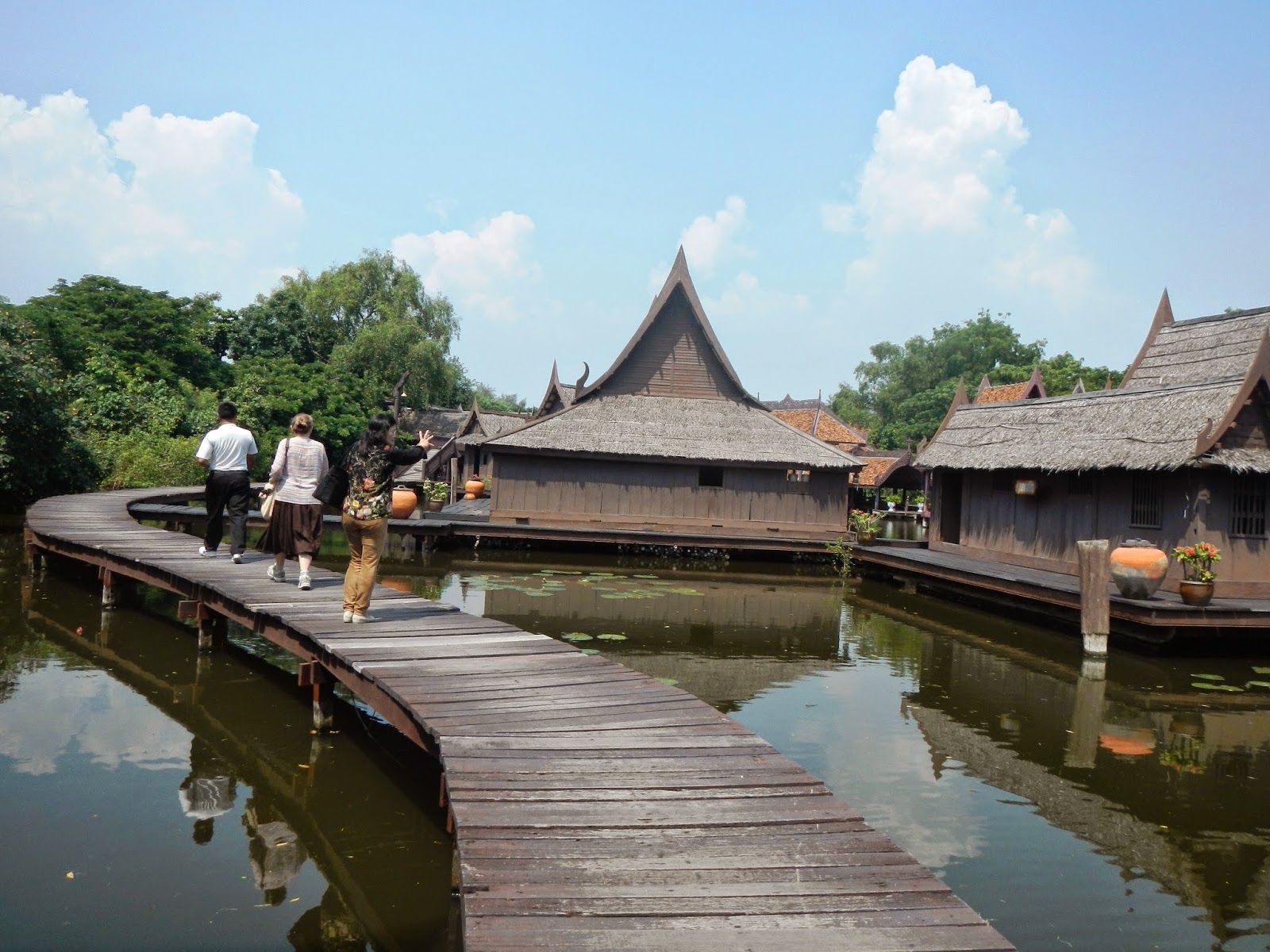
Ancient Siam (formerly known as Ancient City) (Thai: เมืองโบราณ, Mueang Boran) is a park constructed under the patronage of Lek Viriyaphant and spreading over 200 acres (0.81 km2) in the shape of Thailand.
The founder's original idea was to create a golf course with miniatures of Thailand's historically significant structures spread around the course. During his research he found most structures being severely damaged over time and decided instead of creating new miniatures to save the original structures when possible or re-creating them full size or scaled down.
Ancient Siam is dubbed as the world's largest outdoor museum. Situated close to the Crocodile Farm in Samut Prakan province, the 320-hectare city features 116 structures of Thailand's famous monuments and architectural attractions. The grounds of Ancient Siam correspond roughly to the shape of the Kingdom, with each of the monuments lying at their correct places geographically. Some of the buildings are life-size replicas of existing or former sites, while others are scaled down.
The replicas were constructed with the assistance of experts from the National Museum to ensure historical accuracy. Outstanding works include the former Grand Palace of Ayutthaya (destroyed in the Burmese invasion of 1767), Phimai Sanctuary in Nakhon Ratchasima, and Wat Khao Phra Viharn on the Cambodian border.
Ancient Siam is located on the old Sukhumvit Highway, about 33 km south-east of central Bangkok. Golf carts and bicycles can be hired for moving around the park, and private vehicles are also allowed at a fee.
PLEASE ENJOY THE PHOTOS 
(single click photo to enlarge)

 
L-t-R:  Elder and Sister Moleff, Sister Than, Sister Petchfa, Brother Max - he owns the cab that drove us to Ancient Siam, the sea and the Crock and Tiger Park


Sister Petchfa, Map of Ancient Siam, Sister Moleff
Replica of Thai village


Craftsman working on metal


 5th King of Siam (Rama 5)  freed slaves, 100 wives, many children. Beloved by the Thais.


Kings desk


We wanted to take their picture.  They asked us to join them


We ate lunch close by


A wedding.  We wanted to take their picture.  They asked us to join them.


The Andaman sea behind Sister Moleff.  No beach with sand where we were.   Seagulls come in the evening, and when tide goes out you can see the crabs below.


He said go see some movie called King Kong if you want my Family History

This gives new meaning to the saying you got a tiger by the tail


Some contacts just fight to get back in the water and be baptized

This bubbled eyed fish walks on the ground and climbs trees

Saturday, November 15, 2014

Khon Kaen Tri-District Conference

On 18 – 19 October Elder and Sister Moleff attended the Khon Kaen, Udon, and Ubon, Tri-District, conference located in Khon Kaen.  Also on Sunday 19 October, Elder and Sister Moleff attended a Church History Fireside at the Changwattana Chapel.  In addition to serving as a Family History Missionary, Sister Moleff also records the Mission History.

Buses were rented to take members of each district to the conference.  Affordable rooms were rented at police and military establishments to house church members from Saturday evening to Sunday morning

The Saturday session of Conference was held in a large assembly hall in the Ampur Muang Government building.  Internet was not available in the conference hall.  We provided Family History training via Power point presentation.  The Saturday session was presented differently than any other previous district conference session in that booths were prepared that displayed different gospel topics.  The object was that a group of members would move from booth to booth to receive the gospel message prepared for a particular booth.  Family History shared its booth with one on the Endowment.  Lunch and dinner were provided by church members.

A Cultural Program followed the Saturday Session of Conference.

NOTE:  We talked with Elder and Sister Singley, and they support establishing a FH Center in Vientiane, Laos.

Saturday 18 October 2014 Session of Tri-District Conference


Our Family History Booth Backdrop designed by Wisan Manager of Service Center and make by non-member in Khon Kaen.

Our Family History Booth

Sister Wan Interpreting for Elder Moleff.  The fan displayed behind Elder Moleff was made for him at the Umbrella & Fan Company in Chiang Mai.  It is his fan chart as displayed on FamilySearch hand painted on silk.
Sister Wan Doing A Family History Presentation

Endowment Booth

Priesthood Booth

Self Reliance and PEF Booth.  Elder Sepi Speaking.

Thailand 5000 Booth.  Goal is for 5000 to Attend Sacrament Meeting


President Senior Doing the Thailand 5000 Presentation.  
Thailand 5000 is a goal to have 5000 members attend church on 21 December 2014, 
group pictures will be taken after church that day.

There was a cultural event held Saturday evening.
these next pictures are of the dancers from various communities in the Districts.     


Thai Dancers. 
 Sister Moleff had her picture taken with these dancers and the finger decorations.


Notice the One in the Middle out of Uniform
Sister Moleff and Sepi at a park in Khon Kaen


Sunday 19 October 2014 Session of Tri-District Conference


The Sunday session of conference was held at the Charoenthani Khonkaen Hotel where Elder 
and Sister Moleff stayed during district conference. The president authority was Elder Gong
Asia Area President with Elder Khanakham (Area Seventy), and President Senior 

(Mission President) being present.


The conference consolidated the Khon Kaen, Udon, and Ubon districts into the Udon, and 
Ubon districts with the Khon Kaen district being eliminated. The paperwork to create the 
Ubon Stake will be submitted by the end of 2014; and the Udon stake in June 2015. 
New district presidencies and a reorganized mission presidency were sustained.
Photographs are as follows:


Elder Khanakham Conducting.
Elder Khanakham is the first Area Seventy from Thailand. 
He was sustained in April 2014 General Conference
Elder Gong Presiding.  
Asia Area President.
President Wongsagong his interpreter also President of the Udon Disrtict.

Old Udon, Khon Kaen, and Ubon Districts

New Udon and Ubon District

New Ubon District Presidency:  1st Counselor Prawit Soyson;  President Amporn Parapan; 
 2nd Counselor Siridech Sirisukprasert


Our New Missionary District

Sister Moleff started the tradition of going to Swensens ice cream parlor during the week of a missionaries birthday.  It was Elders Moleff's birthday so we went to Big C, where there is a Swensen.   Because we have District Meetings on Tuesdays that is the day we go, which is good because on Tuesdays when  you buy 1 scoop you get another scoop free.  So District Meeting then Swensens.

Swensens was started in 1948 by Earle Swensen, who had learned to make ice cream while serving in the U.S. Navy during World War II.   Swensen opened his first shop at the corner of Union and Hyde Streets, along the cable car tracks in Russian Hill in San Francisco at what had been a failed ice cream parlor. Although vanilla was his lifelong favorite, he developed more than 150 flavors, which he marketed under the motto "Good as Father Used to Make". The original store sold ice cream and other frozen dessert specialties (such as sundaes and banana splits), with primarily take out service. Later other Swensen's franchisees added indoor seating and offered various types of food, including sandwiches and hamburgers.

Today the company is owned by International Franchise Corp (IFC) of Markham, Ontario, Canada, which bought the franchise business from former frozen food manufacturer CoolBrands International in 2006.  The Swensen's chain now includes about 300 franchise outlets worldwide including locations in Asia, the Middle East, the United States, South America, India, Taiwan, Singapore, Cambodia, Malaysia, Philippines, Vietnam, Thailand and Laos.

The company opened its first store in India at Mantri Mall, marking the first of 80 stores over the next 5 years scheduled to open in South India. Swensen's is also now open in Ho Chi Minh City, Vietnam. In March 2014, Swensen's first restaurant in Yangon, Myanmar opened for the first time.


Swensen's serving staff
Our Table


Waiting for our order.  Plus with a Swensens card (which Sister Moleff now has) you also get 10% off your order - Tuesday is a great day to go to Swensens.  Elder and Sister Manning (previous Public Relations Senior Couple) introduced us to Swensens - THANKS.
L-t-R: Elder Howard, Elder Hogan, Elder Kettavong, Sister Moleff, Elder Moleff, Sister Lam, Sister Brown, Elder Davis, Elder Crump, and District Leader Elder Omer

Elder Moleff's 76th Birthday Dinner

Sister Moleff took Elder Moleff to Thailand to celebrate his 76th birthday.
She took him to 1st to the Kamthieng House Museum;
 2nd to the Jim Thompson House & Museum and to lunch,
then to the Central World Plaza Mall for dinner, and, of course, to Swensens for ice cream.
Elder Moleff had a VERY GOOD birthday.  A few photos below:

One of the things that we saw in the Mall was Santa flying around with his reindeer

The Senior Couples stationed at the Service Center helped me celebrate my birthday. 
 Elder Moleff choose to eat at a Thai restaurant - he LOVES Thai food.
Elder Meeker , who served a mission here as a young man, ordered after we told 
him our requests.  The Thai food was served Family Style so that all had a taste 
of the different dishes.  The meal was very good.
L-t-R:  Sister Smith, Sister Ure, Sister Seppi, Sister Meeker, Sister Moleff,

 Elder Moleff, Elder Meeker, Elder Seppi, Elder Ure, and Elder Smith. 
 The Smiths are Public Relations; The Ures aare Humanitarian; The Seppis are PEF;
 The Meekers are the Office Couple and the Moleffs Family History.
A very fine group of people.

Jim Thompson House & Museum

Jim Thompson House Museum, Bangkok Thailand
The Jim Thompson House Museum is the former home of James H.W. Thompson, a self-made American entrepreneur who was the founder of the world renowned Jim Thompson Thai Silk Company. Arriving in Bangkok at the end of World War II, Jim Thompson became passionately interested in Southeast Asian art and antiques. He purchased several old teak houses to create his own unique home in Bangkok in order to house his growing collection. The original Jim Thompson house and outbuildings were re-constructed from all or sections of six separate old houses that were brought from various parts of the country.  After Jim Thompson’s mysterious disappearance inMalaysia in 1967, his nephew Henry B Thompson III generously donated the house and its collection to the people of Thailand.  Open daily to the public for guided tours in English, Japanese, French and Thai, the museum is operated by The James H W Thompson Foundation. Generally the museum remains the way it looked when Jim Thompson lived there, however the Foundation has slightly rearranged certain displays in the interest of security.  Two small buildings, formerly used by household staff, have been turned into additional museum display space.
The Jim Thompson Art Center, a large gallery purpose-built to house special exhibitions is located in the same compound. Exhibitions in the Art Center generally focus on Asian topics or textiles, and range from traditional to modern in theme.  In addition to exhibitions, the Art Center conducts educational and outreach programs, produces publications and collaborates with local and international cultural institutions.  The Art Center also includes in a separate building, the William Warren Library.
As a small independent museum, belonging to an international organisation like ASEMUS that supports museums, will be of benefit in terms of resources, networking and sharing information about our programs.
Jim Thompson House Museum, Bangkok Thailand

Collection size:  1,600 objects
Collection: Asian and Southeast Asian paintings, ceramics, sculpture and object d’art acquired by Jim Thompson.
The collection includes:
Paintings: The Thai paintings in the Thompson collection are on cloth, paper and wood. Most are on cotton and range from fairly small to tapestry size. The subject matter generally relates to either the life of Buddha or the popular Jataka stories, in particular the legend of Prince Vessantara, who shows the virtue of Charity by giving up his worldly possessions, his wife and children.
Ceramics:  The collection includes Chinese export ware, mainly blue and white porcelain, of which numerous pieces found their way to Thailand in the sixteenth and seventeenth centuries. There is also a large collection of Benjarong ware, porcelain originally made to order in China for the Thai nobility.  Sukhothai and Sawankalok wares produced in kilns in Thailand also figure in the collection as do Lopburi and Khmer wares.
Sculpture:  The sculpture in the museum is Southeast Asian, and is principally from Thailand andCambodia, with a few pieces from Burma. The collection includes stone Khmer statues and Buddha images and Burmese wooden figures
Furniture:  The museum has an extensive antique collection of carved, painted and inlayed Thai-Chinese furniture including altar tables, beds and cabinets.  In addition, there is the contemporary furniture Jim Thompson used in his home.


Original architectural drawings for the house, prepared by Thompson and his Thai architect.
During construction, carpenters were brought from Ayutthaya to assemble the old structures.
 
The Jim Thompson House Floor  Plan
Where Sister Moleff took me to lunch at the Jim Thompson House restaurant.  
This is a very restful setting.  If you ever come to visit we will take you to lunch here.
 The Jim Thompson House and grounds are only open from 9am to 5 pm.


A Thai lunch.  The green drink is called Lemon-Grass.  We had the Golden Triangle- crab cakes, prawns wrapped in rice paper, and shrimp - dish on the left.  Middle dish is stir fried vegetables (carrots, baby corn, bamboo shoots, mushrooms,  bell peppers {red & green}, and onions in oyster sauce.  And last rice.  We love the presentation and it tasted even better.
Pulling the thread from the Silk Worm Cacoon.  It is hard to tell but he is pulling
 about a dozed small threads through the hole in the lower wooden bad and 
then he just layers it in the basket.

She is taking the thread from the basket and making hanks of Silk thread. 
 Years ago Sister Peaden gave me three silk cacoons. Now I know what to do with them.

Photos are not allowed in the buildings.  These are photos of the grounds outside 


Silk Worm Cocoons
Silk worms are actually a type of caterpillar that spins silk cocoons around themselves after they turn approximately 1 month old. Whenever they are finally ready to start spinning their cocoon, they will stop eating any food and then they will turn yellowish. At this point, it will then take the silk worm approximately 3 days to spin their cocoon around themselves. If their threads are disturbed by anything, the silk worm will have to start all over again spinning a new cocoon.

The silk that is used in forming these cocoons is actually hardened silkworm saliva that has been secreted from the silk worm's mouth. There is actually a small spinneret that is located on the silk worm's lip, which is used to excreet the silk that they use to form their cocoon. This single strand of silk that the silk worm forms is about 1 mile long. Silk worms have to work in a figure 8 pattern in order to spin their cocoon around themselves.

While spending 3 weeks inside of the cocoon, they shed their skin and change into a pupa and then into moths. The moth will then emerge from its cocoon at dawn by secreting a special spit so that the silk can be dissolved and the moth can emerge. Their wings will be wrinkled before the air puffs them up in an hour and they will also “urinate” a reddish-brown fluid shortly after emerging from their cocoon since it couldn't “pee” while inside of the cocoon. They cannot eat or drink, but they go on to mate for 1 day before laying eggs and dying 5 days later. A female moth can lay between 200 and 500 eggs, which will then hatch into worms in a few weeks and carry on this continuous life cycle.


Wan, our English speaking guide that gave us a good tour.
Both the museum and the house only cost 100 ฿ per person to visit,  1 ฿ = $0.03.  
Entrance fees to the museums was $3.04 each.